Whether you run a consultancy, a coaching practice or a growing team, the way work gets done is changing quickly. Most of what keeps a small business moving is knowledge work: emails, reports, scheduling, research, first drafts. That is exactly the work AI is getting good at, so a warning from one of the people building it deserves attention.
The short answer: AI is unlikely to replace whole teams overnight, but it is already taking over individual tasks, especially the repetitive ones that entry-level roles are built around. The small businesses that do well will be the ones that sort their work task by task, automate the repeatable parts first, and keep judgment and client relationships with people.
What Anthropic's CEO actually said
In May 2025, Anthropic CEO Dario Amodei told Axios that AI could eliminate about half of entry-level white-collar jobs and push US unemployment to between 10% and 20% within one to five years. His reason for saying it publicly: "We, as the producers of this technology, have a duty and an obligation to be honest about what is coming."
The warning landed because it came from inside the industry, not from a critic of it.
What the wider data says
One forecast is not the whole picture. Here is what the other major sources show:
| Source | What it found |
|---|---|
| Dario Amodei, Anthropic (2025) | Up to half of entry-level white-collar jobs at risk, with unemployment of 10–20% possible within one to five years |
| World Economic Forum, Future of Jobs Report 2025 | 41% of employers plan to reduce their workforce where AI can automate tasks by 2030, but 170 million jobs are expected to be created against 92 million displaced, a net gain of 78 million |
| World Economic Forum, Future of Jobs Report 2025 | 77% of employers plan to upskill their workers |
| Anthropic, Econ Scenario Explorer (2026) | In most of its modelled scenarios for 2030, job switching and unemployment stay within ranges history has seen before |
The pattern across all of them: tasks change faster than jobs disappear, and the people most exposed are those whose work is mostly repeatable. Anthropic's own scenario model names coders and call-centre agents as roles that may need to move into less exposed work. We break that model down in Anthropic's three AI scenarios for 2030.
Why this is a forecast, not a fact
Amodei's numbers are a warning about what could happen, not a measurement of what has happened. Several things push the other way:
- AI automates tasks more often than whole jobs. A role is a bundle of tasks. Some get automated, some get faster with AI's help, and some stay entirely human.
- The difference is measurable. Anthropic tracks whether people use its models to augment their work or to automate it outright in its Economic Index, which shows the two are not the same thing.
- Adoption takes time. Even when AI can do a task, businesses still have to set it up, trust it and fit it into how they work.
Which tasks change first in a small business
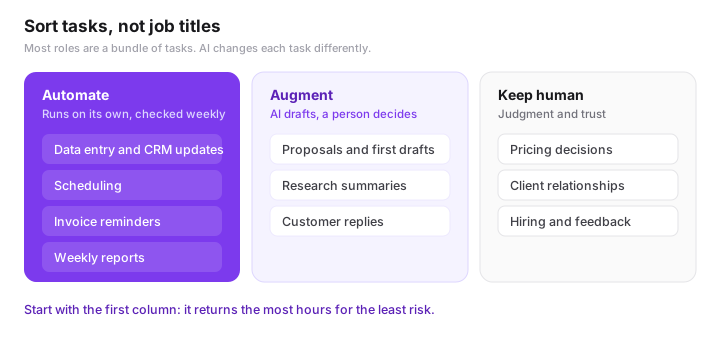
Sorting your team's work into three groups makes the change concrete:
| Group | Typical tasks | What to do |
|---|---|---|
| Automate | Data entry, scheduling, invoice reminders, weekly reports | Hand them to automations and check the output weekly |
| Augment | Proposals, research summaries, customer replies | Let AI draft, and have a person edit and approve |
| Keep human | Pricing decisions, client relationships, hiring and feedback | Keep these with people, and give them the hours saved |
If you want a deeper list, our founder's guide to AI agents walks through the five tasks most worth automating first.
What small businesses can do about it
- List tasks, not job titles. Write down what each person actually does in a typical week.
- Automate the repeatable first. Reports, follow-ups, scheduling and data entry are the tasks AI handles well today.
- Keep judgment and relationships human. Clients still want a person who understands their situation and makes the call.
- Make AI part of everyone's job. The WEF found most employers plan to upskill rather than only cut. Small teams can move faster on this than large ones.
- Start with one workflow. Prove the time savings on one process before you expand to the next.
The question isn't whether AI replaces your team. It's whether your team uses it before your competitors do.
What it means for coaches, consultants and scaling teams
Small teams can now do work that once needed a larger headcount, but only if the tools are set up well and someone owns them. That is the gap GenExecutive fills. We run your back-office support, set up AI agents and automations for the repetitive work, and build custom tools when a spreadsheet stops being enough. Anything sensitive waits for a person's approval before it goes out.
Want to put AI to work in your business? Book a free call and get a fixed quote before any work begins.
Frequently asked questions
Will AI replace entry-level jobs by 2030?
Some, but probably not most. Anthropic's CEO has warned that up to half of entry-level white-collar jobs could go within five years, while the World Economic Forum expects more jobs to be created than lost by 2030. The most likely outcome is that entry-level roles change shape: fewer repetitive tasks, more reviewing, editing and client work.
Which jobs are most exposed to AI?
Roles made up mostly of repeatable knowledge tasks: data entry, scheduling, basic research, first-draft writing, routine coding and call-centre work. Anthropic's scenario model specifically names coders and call-centre agents as roles that may need to move into less exposed work.
Should small businesses hire fewer junior staff?
Not automatically. A better question is which tasks a junior hire would spend their week on. If most of them can be automated, automate those first and hire for the work that needs judgment and client contact, ideally someone comfortable working alongside AI tools.
How do I start using AI without risking quality?
Pick one repeating process, keep a person reviewing the output at first, and measure the hours saved. Loosen oversight only once the results are consistently right. Anything that goes out under your name, such as a refund, a contract or a client email, should always have a human approval step.
Sources: Axios on Dario Amodei's warning · World Economic Forum, Future of Jobs Report 2025 · Anthropic, Scenarios for our economic future · Anthropic Economic Index