Will AI lead to a boom, mass unemployment, or something in between? Anthropic's economics team doesn't claim to know. Instead, it built a model, the Econ Scenario Explorer, that lets anyone test different futures for US jobs, growth and wages by 2030. It is based on the technical report Economic Scenarios for Transformative AI by Anton Korinek, Chad Jones, Szymon Sacher, Tess Cotter and Peter McCrory (2026).
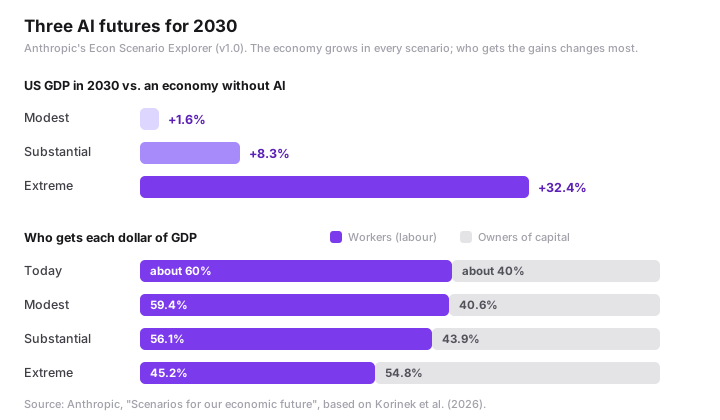
The short answer: in all three of Anthropic's scenarios, AI makes the US economy bigger by 2030, by 1.6%, 8.3% or 32.4% depending on how capable AI becomes and how fast it is adopted. The bigger change is in who benefits: the more powerful AI gets, the more of each dollar goes to the owners of capital rather than to workers. For small businesses, the practical lesson is the same in every scenario: sort your work task by task and automate the repetitive parts first.
The core idea: jobs are bundles of tasks
The model breaks every job into tasks, using the US Department of Labor's task lists, and asks what AI does to each one. Anthropic uses a nurse as the example:
| Task | What AI does to it |
|---|---|
| Bathe a patient | Unchanged: only a person can do it |
| Draft discharge instructions | Augmented: AI helps the nurse do it faster |
| Monitor patients remotely | Augmented |
| Plan the shift's care schedule | Augmented |
| Chart vitals | Automated: AI does the whole task |
| Order ward supplies | Automated |
| Review an AI-proposed care plan | New task, created by AI |
The job doesn't disappear. It changes shape, and the nurse may get more time with patients. Add up millions of changes like this across the economy and you get Anthropic's scenarios.
Anthropic's three scenarios for 2030
- Modest (+1.6% GDP). AI has roughly the same kind of impact the internet did: real gains, within the historical norm for new technologies, arriving gradually.
- Substantial (+8.3% GDP). AI can do half of all knowledge work by 2030, most of it autonomously, but it isn't adopted for all of it. The economy grows at twice its normal rate, a bigger impact than the internet or the railroad.
- Extreme (+32.4% GDP). AI is more productive than people at the vast majority of knowledge-work tasks. Growth reaches 15% a year, doubling the economy about every 4.5 years. Anthropic says this would likely require AI that improves itself, adopted quickly.
| Scenario | US GDP in 2030 vs. no AI | In 2025 dollars |
|---|---|---|
| Modest | +1.6% | $34.1 trillion |
| Substantial | +8.3% | $36.3 trillion |
| Extreme | +32.4% | $44.4 trillion |
Four key findings
- AI grows the economy in every scenario. The size of the gain varies enormously, but none of the scenarios shrinks it.
- More people switch jobs. Coders and call-centre agents may need to move into less exposed work, such as electrician or nurse. Changing occupation is hard and slow for many people. In most scenarios, job switching and unemployment stay within ranges history has seen; in the extreme one, unemployment rises beyond typical recession levels.
- Wages rise unevenly. Pay for knowledge workers is roughly flat in the substantial scenario and falls by more than 10% in the extreme one, while other workers gain.
- Capital takes a bigger share. The economy grows, but owners of capital get a larger slice of it:
| To workers (labour) | To capital | |
|---|---|---|
| Today | about 60% | about 40% |
| Modest | 59.4% | 40.6% |
| Substantial | 56.1% | 43.9% |
| Extreme | 45.2% | 54.8% |
Anthropic's conclusion: in the most extreme case, the main challenge is not achieving economic growth but making sure the benefits are broadly shared.
What do Americans expect?
Anthropic surveyed more than 10,000 Americans in August 2026. The typical respondent's answers implied an outcome close to the substantial scenario: GDP about 10% higher by 2030 than without AI, and unemployment rising to around 5%. About 10% of respondents held views in line with the extreme scenario.
How to read the model
This is version 1.0, and Anthropic is clear that it is a stark simplification. It leaves out policy responses, business cycles, swings in demand and financial markets, and catastrophic risks. It doesn't follow individual workers, so it gives only a rough picture of what displacement costs people, and it excludes highly capable robots. Treat it as a tool for thinking about the range of outcomes, not a forecast of any one of them.
What small business owners can do now
The scenarios differ on how fast change arrives, not on its direction. In every one of them, the businesses that adapt task by task do better than those that wait.
- List tasks, not job titles. Write down what your team actually does in a week.
- Sort each task. Which need a person, which could AI speed up, and which could run on their own?
- Automate the repetitive ones first. Inbox triage, follow-ups, invoicing and reporting are common starting points. Our founder's guide to AI agents covers the five best candidates.
- Plan for the new tasks. Someone has to review what AI produces and own each process, just like the nurse reviewing an AI care plan.
That is how GenExecutive works with clients. We start with a workflow audit, then combine back-office support, AI agents and automations and custom tools, with human approval on anything sensitive. For the jobs side of the debate, read will AI replace entry-level jobs?
Want to find out which of your tasks AI should take on? Book a free call and get a clear picture of where to start.
Frequently asked questions
What is Anthropic's Econ Scenario Explorer?
It is an interactive economic model from Anthropic's economics team, released as version 1.0 in September 2026. It breaks jobs into tasks, estimates how AI changes each one, and shows the resulting effects on US GDP, wages, unemployment and the split between labour and capital by 2030.
What are Anthropic's three AI scenarios?
Modest, where AI has an internet-sized impact and GDP is 1.6% higher by 2030; substantial, where AI can do half of knowledge work and GDP is 8.3% higher; and extreme, where AI outperforms people at most knowledge work and GDP is 32.4% higher.
Will AI cause mass unemployment by 2030?
Not in most of Anthropic's scenarios. Unemployment stays within historical ranges in the modest and substantial cases, though more people switch jobs. Only in the extreme scenario does unemployment rise beyond typical recession levels.
Who gains the most from AI in Anthropic's model?
Owners of capital. Workers' share of each GDP dollar falls from about 60% today to 56.1% in the substantial scenario and 45.2% in the extreme one, even though the overall economy grows.
Source: Anthropic, Scenarios for our economic future, based on Economic Scenarios for Transformative AI (Korinek, Jones, Sacher, Cotter and McCrory, 2026).